
Choosing the wrong track shoe width ruins your undercarriage 1 quickly. It causes expensive downtime, increases fuel costs, and frustrates your customers. I will help you select the right size today.
Widening your track shoe assembly spreads the machine's weight, reducing ground pressure for soft soil. However, it increases stress on pins and bushings. Narrower shoes improve maneuverability and durability on hard ground. Selecting the correct width balances flotation with component life.
Let us look at the specific numbers, rules, and physics to help you make the best choice for your fleet and your customers.
How do I calculate the ground pressure (PSI or kPa) for my machine when using your different shoe widths?
You do not need to guess if a machine will sink. Simple math gives you the exact answer to share with your engineers.
To calculate ground pressure, divide the machine’s operating weight by the total ground contact area. You find the area by multiplying the track width by the length of track on the ground. A lower number means better flotation.
Calculating ground pressure is a vital skill for a procurement director like yourself. It allows you to prove to your customers why a specific shoe is necessary, rather than just guessing based on appearance. We often use this calculation at Dingtai to confirm that a custom order meets the technical requirements of the job site before we begin manufacturing.
The formula is simple logic. You have a heavy weight, and you are spreading it out over a specific area. The basic formula for Ground Pressure ($P$) is:
$$P = \frac{W}{A}$$
Where:
- P is Pressure (PSI or kPa).
- W is the Operating Weight 2 of the machine.
- A is the Total Contact Area (Width of shoe × Length of track on ground × 2 tracks).
Let us walk through a practical example using a standard 20-ton excavator 3. We will compare a standard 600mm shoe against an 800mm shoe to see the real difference in numbers.
Scenario A: 600mm Shoes (Standard)
- Weight: 20,000 kg (approx. 44,092 lbs).
- Track Length on Ground: 3,500mm (approx. 138 inches).
- Shoe Width: 600mm (approx. 24 inches).
- Total Area: $600 \times 3,500 \times 2 = 4,200,000 \, mm^2$ (or $4.2 \, m^2$).
- Result: The pressure is higher. The machine digs into the ground effectively for traction.
Scenario B: 800mm Shoes (Wide/LGP)
- Weight: 20,400 kg (Weight increases because the wider shoes contain more steel).
- Track Length on Ground: 3,500mm.
- Shoe Width: 800mm (approx. 31.5 inches).
- Total Area: $800 \times 3,500 \times 2 = 5,600,000 \, mm^2$ (or $5.6 \, m^2$).
- Result: The area increased significantly. Even though the machine is heavier, the pressure drops by roughly 23%.
Here is a data table you can use for quick reference when explaining this to your clients:
| Specification | 600mm Shoe (Standard) | 800mm Shoe (Wide) | Impact |
|---|---|---|---|
| Contact Area | 4.2 $m^2$ | 5.6 $m^2$ | +33% Surface Area |
| Machine Weight | 20,000 kg | 20,400 kg | +2% Operating Weight |
| Ground Pressure | ~47 kPa (6.8 PSI) | ~36 kPa (5.2 PSI) | -23% Ground Pressure |
When you present these numbers, you show your expertise. If a customer needs to reach 5 PSI to work safely on a wet site, the math proves they need the 800mm shoes. However, if they are working on hard ground where ground pressure 4 is not an issue, this calculation shows them that the extra width provides no benefit and only adds cost and weight.
Do wider shoes (LGP) make it significantly harder for the machine to turn (e.g., "power hop")?
Drivers hate it when a machine jumps or stalls during a turn. We call this "power hop," and it feels terrible in the cabin.
Yes, wide shoes (LGP) increase turning resistance significantly. On hard ground, the outer edges of the shoe dig in, forcing the engine to work harder. This causes the machine to "hop" or jerk, which places massive stress on the final drive.
"Power hop" is a term you hear often in the field, but understanding why it happens helps you prevent warranty claims. It occurs when the resistance of the ground is greater than the smooth torque of the drive motors. The tracks build up tension, stick, and then suddenly release. This causes the machine to bounce or shudder violently.
When an excavator turns, it does not steer like a car with wheels. It skids. The center of the track stays relatively still, but the front and rear of the track must slide sideways across the ground. With a wide LGP (Low Ground Pressure) shoe, the "lever arm" from the center of the chain to the edge of the shoe is long.
If you are on soft mud, this is fine because the mud moves and displaces easily. But on hard soil, compacted clay, or rock, that wide edge digs in. It acts like an anchor. The final drive motor tries to push the track, but the ground holds it back. The hydraulic pressure builds up until the track violently breaks free and skips.
This hopping motion is destructive in three specific ways:
- Final Drive Damage: The shock loads from the hopping travel straight into the gears of the planetary drive 5. This can shatter gear teeth or shear off mounting bolts.
- Hydraulic Heat: The system has to run at maximum pressure (relief pressure) to force the turn. This generates excess heat rapidly, which degrades hydraulic seals 6 and shortens the life of the pumps.
- Operator Fatigue: A jerky machine makes for a tired operator. Tired operators make mistakes, which can lead to accidents or further equipment damage.
Operational Advice
If your client effectively must use wide shoes on harder ground (perhaps they are crossing a hard patch to get to a swamp), you should advise them on technique. They should make wide, gradual turns rather than sharp pivots. They should never try to "counter-rotate" (spin in place) with wide shoes on hard ground. As a supplier, if you see an order for LGP shoes going to a rocky region like a quarry, you should ask questions. It might save them a final drive replacement later, and they will thank you for the foresight.
Will using wider shoes than standard cause more stress and wear on my track chain and rollers?
A wide shoe acts like a giant lever. It twists your chain and crushes your rollers every time you hit a bump.
Using shoes that are too wide for the terrain causes premature wear. The extra width creates a lever arm that twists the track links and increases load on rollers. This often leads to cracked shoes, leaking seals, and broken pins.
This is the most critical point for a quality-focused buyer like you. The number one cause of premature undercarriage failure is not "bad steel"—it is using wide shoes on uneven ground. Even the best heat-treated steel 7 from my factory in Fujian cannot fight the laws of physics forever.
Think of the track shoe as a seesaw or a teeter-totter. The track chain 8 is the pivot point in the middle.
- Narrow Shoe: The distance from the chain to the edge of the shoe is short. If the edge hits a rock, the twisting force (torque) on the chain is small.
- Wide Shoe: That distance is long. When the edge of a wide shoe steps on a rock or stump, it creates a massive twisting force. This force tries to rip the track pin out of the link. It pries the link joint open.
This twisting leads to "Dry Joints." Your track chains are sealed and lubricated. Oil is trapped inside the pin and bushing to prevent internal wear. When a wide shoe twists the link, it momentarily opens a gap in the seal.
- The oil leaks out.
- Dirt and abrasive sand get in.
- Once the oil is gone, internal wear accelerates instantly. A chain that should last 4,000 hours might fail in 1,500 hours.
It is not just the chain that suffers; the structural integrity of the shoe itself is at risk. We see this often in claims: a customer complains that the shoes are bending or cracking. When we check the site photos, we see they are using 800mm shoes on a demolition site with concrete debris. The shoe is unsupported at the edges. The weight of the machine bends the steel plate until it snaps.
Here is a breakdown of how oversized shoes affect specific components:
| Component | Effect of Oversized Shoes | Consequence |
|---|---|---|
| Track Link | High Torsion / Twisting | Dry joints, elongated pitch, "kinking" of the chain |
| Track Shoe | High Bending Moment | Cracks in the plate, bent grousers, loose bolts |
| Bottom Roller | Uneven Loading | Flange wear, internal shaft damage, seal failure |
What is the standard "rule of thumb" for choosing the narrowest shoe possible that still supports my machine?
Many buyers think "bigger is better." In the undercarriage world, the opposite is usually true.
The golden rule is to always choose the narrowest shoe that provides adequate flotation. If the machine does not sink, a narrower shoe is better. This maximizes part life, reduces stress on joints, and lowers the cost per hour of operation.
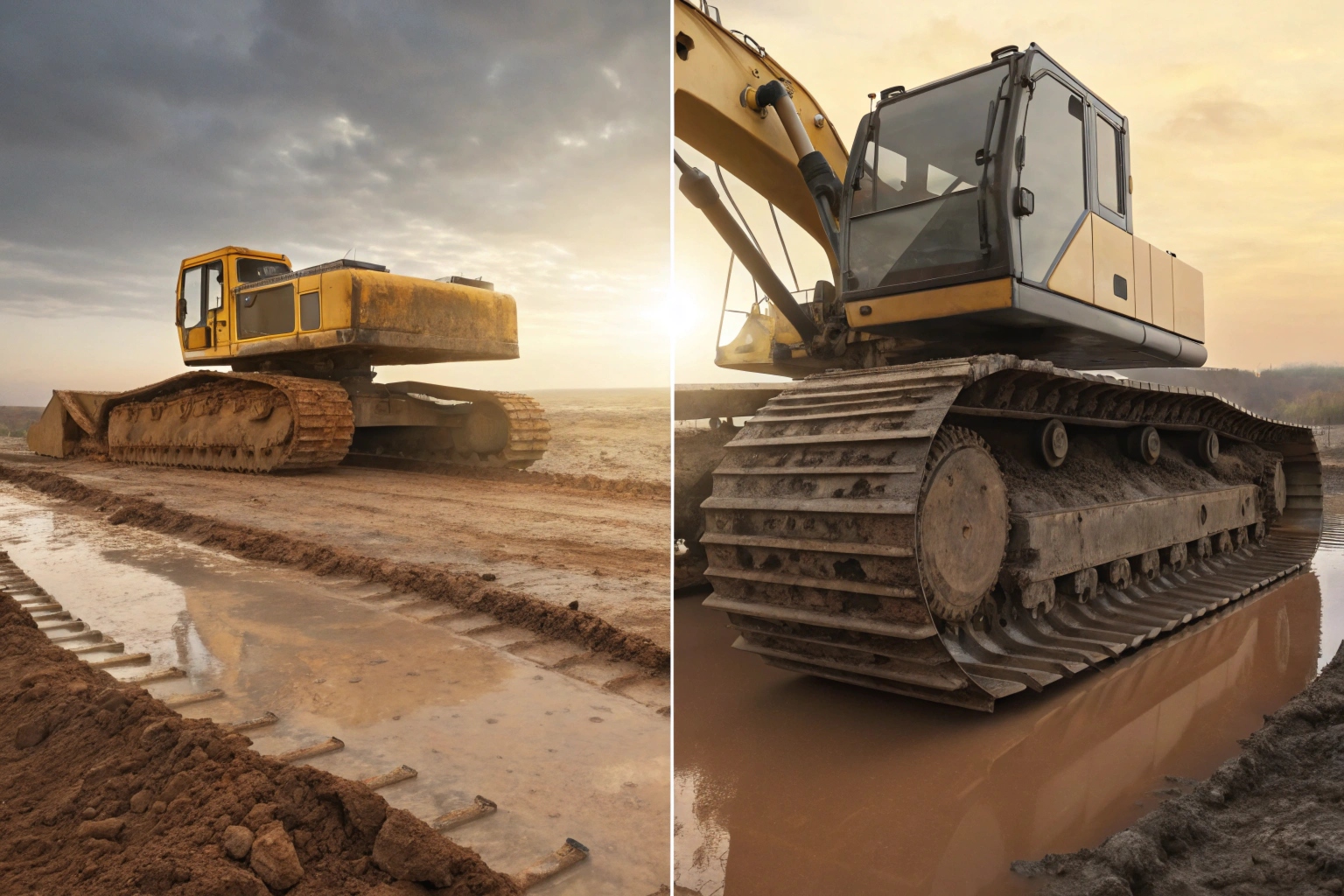
If you remember only one thing from this article, let it be this rule. It is the standard advice given by major OEMs like Caterpillar and Komatsu, and we strictly follow it at Dingtai when advising our distributors.
The goal of the undercarriage is to support the machine. Once the machine is supported and not sinking, any extra width becomes a liability. It is dead weight and a source of stress.
- Narrow shoes penetrate the ground better. This gives superior traction 9 (grip) for pushing and digging.
- Narrow shoes are structurally stronger. They are less likely to bend under impact.
- Narrow shoes are cheaper. They use less raw material and cost less to ship internationally.
How to Apply the Rule
When you speak to your customers, you need to act as a consultant. Ask them about the "worst" ground condition they face 20% of the time. Do not size the shoe for the 1% of the time they might cross a rain puddle. Size it for the majority of their work.
If a customer says, "I mostly work on dirt, but sometimes it rains," stick to the standard width (e.g., 600mm for a 20-tonner). The standard shoe can handle some mud.
If they say, "I am clearing a mangrove swamp or working on loose peat," then—and only then—do you sell them the wide shoes.
There is a simple checklist you can use to survey the job site requirements:
Job Site Shoe Selection Checklist
| Condition | Recommended Action | Reason |
|---|---|---|
| Rocky / Impact | Use Narrowest Shoe | Prevents bending and link twisting. |
| Firm Soil / Clay | Use Standard Shoe | Balances traction and flotation. |
| Swamp / Loose Sand | Use Wide (LGP) Shoe | Maximizes flotation to prevent sinking. |
| Mixed Terrain | Use Standard Shoe | Favor durability over occasional flotation needs. |
As a distributor, following this rule protects your reputation. If you sell a customer wide shoes because they "look tough," and those shoes break in six months because the customer worked on rock, they will blame your brand. They will say your parts are low quality. By advising them to use the narrowest possible shoe, you ensure the parts last longer. You save them money on fuel and repairs. This builds the trust that keeps them coming back to you for years.
Conclusion
To maximize durability, always calculate the ground pressure and select the narrowest shoe that prevents sinking. This reduces stress, prevents power hop, and extends the life of the undercarriage. Would you like me to help you calculate the optimal shoe width for your next stocking order?
Footnotes
1. Overview of the undercarriage framework in heavy machinery. ↩︎
2. Definition of operating weight including operator and fluids. ↩︎
3. Guide to hydraulic excavators and their applications. ↩︎
4. Explanation of physics behind ground pressure distribution. ↩︎
5. Mechanics of planetary gear systems in machinery. ↩︎
6. Importance of mechanical seals in hydraulic systems. ↩︎
7. How heat treatment improves steel durability. ↩︎
8. Function of continuous tracks in vehicle mobility. ↩︎
9. Physics of traction and grip on various terrains. ↩︎
10. Definition of Original Equipment Manufacturer in industry. ↩︎