
Finding a reliable partner for undercarriage parts is hard because many sellers claim to be factories when they are just middlemen. I know how frustrating it is to realize your "manufacturer" has no control over quality or delivery times.
To verify if a supplier is a real manufacturer, you must check their business license for "production" scope, verify that their ISO9001 certificate covers "manufacturing," and request live video proof of their heat treatment and production lines in action.
Buying from a middleman adds cost and risk to your supply chain 1. When you work with a direct factory like Dingtai, you get clear answers and stable quality. Let me show you exactly how to separate the real makers from the traders.
What documents can prove you are a manufacturer?
You might worry that a piece of paper is easy to fake, but official Chinese records are very specific. I have seen many trading companies try to hide behind fancy brochures while their legal papers tell a completely different story.
Official proof comes from a Business License that lists "Manufacturing" or "Processing" in its scope, and a 13% VAT invoice issued directly by the company for the specific goods they produced in their own facility.
In China, every company has a "Business Scope" on its license. If a company is a trader, their scope will only say things like "Sales," "Wholesale," or "Export." A real factory like Dingtai must have words like "Production," "Manufacturing," or "Processing" (制造 or 加工). If they cannot show you this, they are not making the parts themselves.
Another key document is the ISO 9001 certificate 2. You should look closely at the "Scope of Certification." A trading company's certificate might only say "Sales and Service." Our certificate at Dingtai explicitly covers the "Production and Manufacture of Undercarriage Parts." This means auditors have actually visited our workshops to verify our processes.
Key Document Checklist
| Document Type | What to look for (Manufacturer) | What to look for (Trader) |
|---|---|---|
| Business License | Includes "Production" or "Manufacturing" | Only says "Sales" or "Consulting" |
| ISO 9001 Scope | Explicitly mentions "Manufacturing" | Mentions "Trading" or "Sales" only |
| VAT Invoice | 13% tax rate under their own name | May use a third-party billing name |
| Audit Reports | Includes photos of heavy machinery | Often missing or very generic |
Can you show me photos of your steel inventory and production lines?
I understand that seeing is believing, especially when your business depends on the durability of steel. Some sellers use stock photos from the internet, which makes it very hard for you to trust what is actually happening in the workshop.
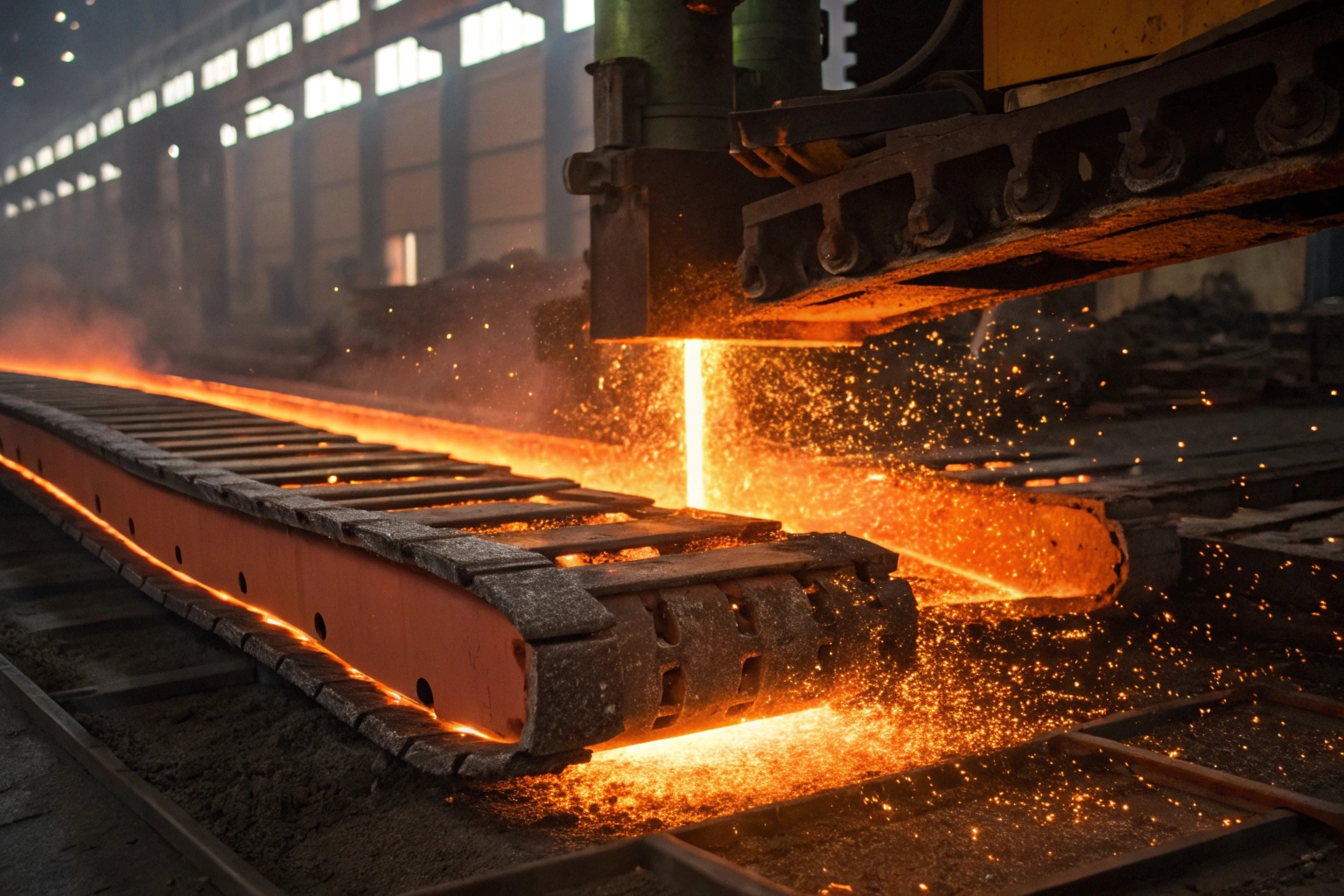
Yes, a real manufacturer can provide real-time photos or a live video call showing their raw steel bar inventory, induction hardening furnaces, and CNC machining centers with staff wearing company-branded uniforms.
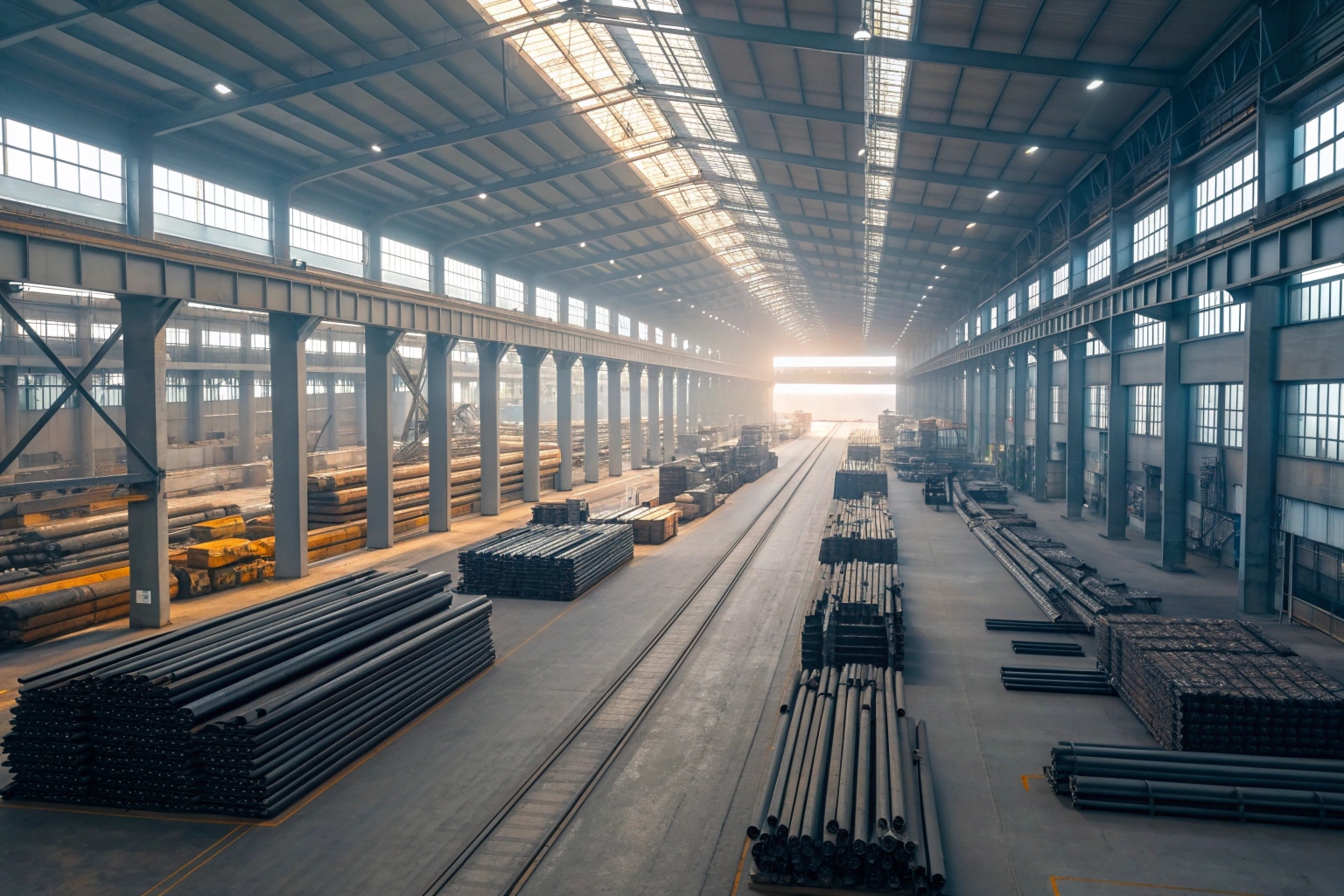
A factory always has a "smell" and a "look" that a trading office cannot copy. When you ask for photos, look for the scale. For track shoe assemblies, we need massive amounts of raw steel 3. At Dingtai, we keep a large inventory of steel bars to ensure we can meet big orders without waiting for market fluctuations.
You should also look at the heat treatment 4 area. This is the heart of making undercarriage parts last long. If a supplier cannot show you their own induction hardening 5 furnaces or spray quenching lines, they are likely outsourcing the most important part of the job. This means they cannot guarantee the hardness depth or the consistency of the parts you receive.
Production Equipment Comparison
| Equipment Category | Purpose in Manufacturing | Importance for Quality |
|---|---|---|
| Steel Inventory | Traceability of raw materials | High - ensures batch consistency |
| Heat Treatment | Hardens the surface of track shoes | Critical - determines wear life |
| CNC Centers | High-precision machining | High - ensures perfect fitment |
| Testing Lab | Checks hardness and material grain | Critical - 100% quality check |
Are you listed as the manufacturer on your ISO9001 certificate?
It is common for traders to show you an ISO certificate that belongs to someone else. I have seen David and other buyers get confused because the name on the certificate doesn't match the name on the proforma invoice or the website.
A legitimate manufacturer like Dingtai will be listed as the primary entity on the ISO9001 certificate, with an "Authorized Scope" that specifically includes the design and production of undercarriage components.

When you check our ISO9001 certificate, you can verify it through the official government database 6. The registered address on the certificate should match the address where the goods are being shipped from. Trading companies often have an office in a city center (like Xiamen or Shanghai), but their "factory" is hundreds of miles away in an industrial zone.
At Dingtai, our office and our 100+ employees are all located at our production base in Nan'an, Fujian. This means when you call us, the person you talk to can walk down to the factory floor in two minutes to check on your order. We are the ones who control the quality management system 7, not a third party. This direct control is why we can offer the 100% inspection guarantee that David requires for his premium brand 8.
Understanding Certification Scopes
| Scope Type | Meaning for the Buyer |
|---|---|
| Design & Production | The company creates and makes the parts. |
| Manufacturing | The company has the machines to make the parts. |
| Sales & Distribution | The company only buys and sells parts. |
Why is it better and safer for me to buy directly from a manufacturer?
I know you want to save money, but the real benefit of buying from a factory is "peace of mind." Dealing with a trader who doesn't understand the difference between 40Mn2 and 45Mn steel is a recipe for disaster on the job site.
Buying directly from a manufacturer like Dingtai is safer because it eliminates middleman markups, ensures direct technical support, provides full material traceability, and guarantees a much faster response if a quality issue occurs.
When you work with a factory, you are talking to the people who actually know the heat treatment data and the chemical composition 9 of the steel. For someone like David, who sells these parts under his own brand, one bad batch can ruin 20 years of reputation. A trader might just disappear or blame the factory when things go wrong.
We take full responsibility because we made the part. If you have a special request for a heavy-duty mining environment 10, our 20+ technical experts can adjust the production process for you. A trader cannot do that; they can only sell you what is "on the shelf." Furthermore, our lead times are more reliable because we control the production schedule. We don't have to wait for another company to tell us when your order will be finished.
Conclusion
Verifying your supplier takes a little work, but it saves you from huge losses later. Check the licenses, look at the machines, and talk to the experts. If you want to see our factory in action, just ask!
Footnotes
1. Understand the flow of goods and services from raw materials to final products. ↩︎
2. Official standard for quality management systems to ensure customer satisfaction and product quality. ↩︎
3. Resources on global steel production, properties, and its vital role in modern infrastructure. ↩︎
4. Technical overview of heating and cooling processes used to alter metal physical properties. ↩︎
5. Explanation of the induction process used to selectively harden the surface of metal parts. ↩︎
6. China’s official administration for certification and accreditation to verify company credentials. ↩︎
7. A formal system that documents processes, procedures, and responsibilities for achieving quality policies. ↩︎
8. Strategies and insights into building a high-value, high-quality brand identity. ↩︎
9. Database providing information on the chemical properties and compositions of various materials. ↩︎
10. Information on machinery and parts designed to withstand extreme conditions in mining operations. ↩︎