
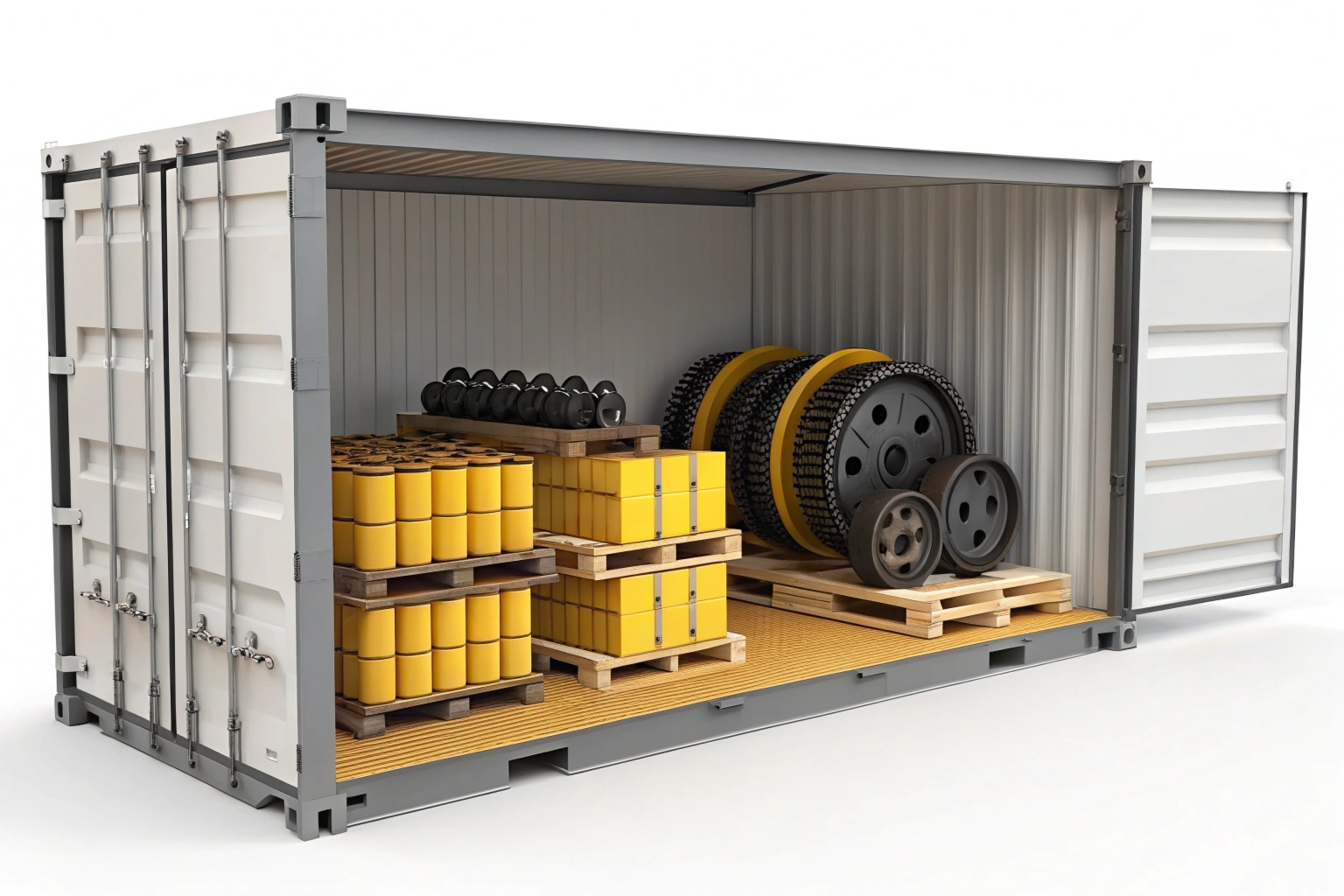
I know that paying for "empty air" in a shipping container hurts your bottom line. You want to maximize every shipment to lower your landed costs 1, but you might worry that mixing different models will lead to damage or confusion at your warehouse.
Yes, you can mix different models (SKUs) of track shoe assemblies in the same container. This standard industry practice optimizes shipping costs and inventory flow. We strictly organize pallets by SKU, label them clearly, and balance the weight distribution to ensure safe transit and easy unloading at your facility.
Let's break down exactly how we handle these mixed shipments to ensure your operations run smoothly.
How will you label the different pallets to make it easy for my receiving team to identify them?
I have seen warehouses turn into chaos because pallets looked identical from the outside but contained different parts. I want to make sure your forklift drivers know exactly what they are moving the moment they open the doors.
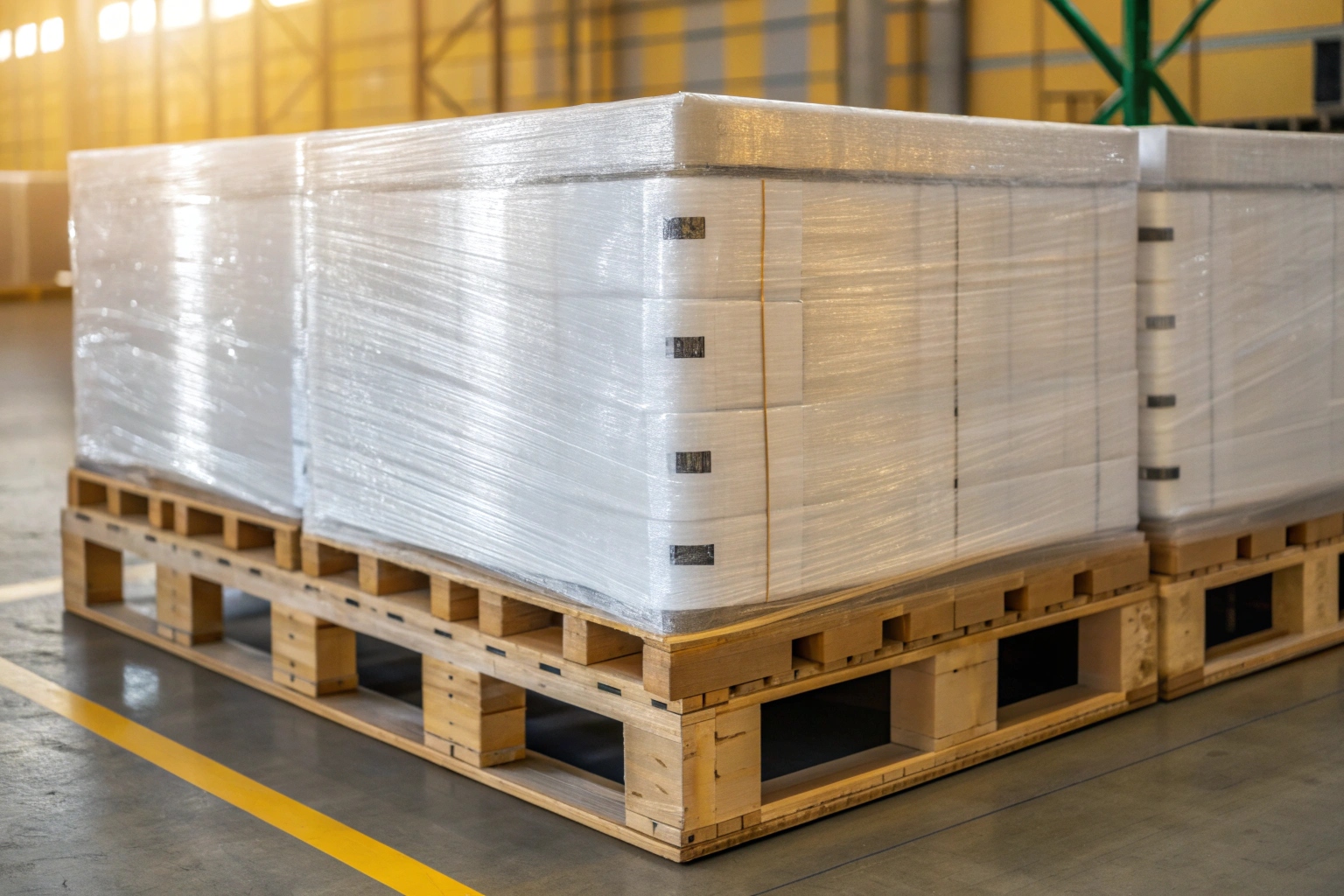
We label every pallet on two adjacent sides with high-contrast, waterproof labels. These labels clearly list the Model Number (SKU), Part Name, Quantity, and Order Number. We can also apply color-coded tags or your specific barcodes to help your receiving team identify items instantly without needing to break the shrink wrap.
When dealing with heavy undercarriage parts, the "visual management" 2 of the load is just as important as the physical quality of the steel. Your warehouse team should not have to guess, climb over pallets, or check a piece of paper every time they look at a crate. We use a labeling system designed for speed, accuracy, and the harsh realities of ocean transport.
First, let's talk about label placement. We adhere to a "Two-Side Rule." We place labels on two adjacent sides of the pallet (usually the front face and the right-hand side). This is a critical detail that many suppliers overlook. When pallets are packed tightly in a 20ft container, one side is often blocked by a wall or another pallet. By labeling two sides, your forklift operator can always identify the goods regardless of how the pallet is oriented or buried in the container. This saves valuable minutes per pallet because your team does not have to pull the pallet out and spin it around just to read the SKU.
Second, the material of the label matters. A standard paper label will peel off or become unreadable after 40 days of humidity on the ocean. We use synthetic, weather-resistant labels that withstand moisture, friction, and dust. We print the information in large, bold font—not handwritten marker scrawls that leave room for interpretation errors. We can also include your internal part numbers directly on our labels. This means your receiving team can match the physical goods to your ERP system 3 immediately, without needing a conversion chart.
Labeling Feature Comparison
| Feature | Standard Supplier Labeling | Dingtai Custom Labeling | Benefit for Your Operations |
|---|---|---|---|
| Placement | Single side only | Two adjacent sides | Identifiable from multiple angles without moving the pallet. |
| Material | Standard Paper | Waterproof Synthetic | Resists moisture damage and peeling during ocean transit. |
| Data Content | Part Number only | Part #, Qty, Batch ID, Wgt | Provides complete data for inventory and quality tracing. |
| Visual Aid | Black & White text | Color-coded Tags (Optional) | Allows for rapid visual sorting (e.g., Yellow for Komatsu parts). |
Finally, for mixed containers, we can implement a color-coding system. If your order contains track shoes for three different brands—say, Caterpillar, Komatsu, and Hitachi—we can apply different colored tape or stickers to the pallets. A glance is all it takes for your driver to know: "Blue tape goes to Aisle 4, Red tape goes to Aisle 5." This reduces the cognitive load on your staff and minimizes the risk of putting stock in the wrong location.
Will the packing list be extremely clear, itemizing exactly which models are on which pallet?
You hate guessing games, and you certainly do not want to spend hours cross-referencing a messy invoice against a pile of boxes. You need a document that acts like a map.
Your packing list will be a precise map of the container. We itemize exactly which SKUs are on which numbered pallet. This document matches your physical labels 100%, allowing your forklift operators to cross-reference items immediately upon opening the container doors.

A packing list is not just a receipt; it is an instruction manual for your receiving department. When we ship mixed containers with multiple SKUs, the complexity increases. If the paperwork is vague, your team wastes hours breaking down pallets to count items. We treat the packing list as a critical part of the product itself, ensuring it adds value rather than confusion.
We utilize a "Pallet Map" system in our documentation. Before we close the container doors, we number every single pallet physically, from 1 to 20 (or however many fit). On the digital and printed packing list, you will see a specific breakdown. It does not just say "100 pcs of Track Shoe A." It says "Pallet #1: 20 pcs of Track Shoe A; Pallet #2: 20 pcs of Track Shoe A." This granular level of detail allows your inventory manager to know exactly where every single unit is located before the container is even unloaded.
Sample Packing List Structure
| Pallet No. | SKU / Model | Description | Qty (pcs) | Net Weight (kg) |
|---|---|---|---|---|
| 01 | CR5569 | Track Shoe Assy D6R | 20 | 1,200 |
| 02 | CR5569 | Track Shoe Assy D6R | 20 | 1,200 |
| 03 | MIXED | See below | 950 | |
| 03-A | KM-200-1 | Track Roller PC200 | 10 | 350 |
| 03-B | KM-200-2 | Carrier Roller PC200 | 20 | 600 |
This level of detail is also a massive advantage when dealing with customs. Customs officers often want to inspect specific items based on their HTS codes 4. If the paperwork simply says "Undercarriage Parts - Mixed," they might order a full strip (unloading) of the container to find what they are looking for, which causes delays and high examination fees. If the paperwork says "The PC200 Rollers are on Pallet #3," the officers can target just that pallet. This transparency builds trust with US Customs 5 and speeds up the clearance process significantly.
We send you the digital version of this detailed packing list (in Excel or PDF) as soon as the container is loaded. You can upload this data into your inventory management system days or weeks before the ship arrives. This allows your team to print their own internal warehouse labels and clear the specific shelf space required. When the truck arrives at your dock, your team is already prepared with a plan, turning a potentially chaotic mixed load into a routine receiving job.
Is there any extra charge for mixing and sorting many different SKUs in one FCL shipment?
You need to know if our extra sorting labor will increase your unit price or if you will see surprise "handling fees" on your final invoice.
We do not charge extra fees for mixing and sorting standard SKUs in a Full Container Load (FCL). As a direct manufacturer, we consider efficient loading part of our service. You get the benefit of optimized freight rates without hidden surcharges for order consolidation.
Many trading companies or third-party logistics 6 providers operate on a model where every touchpoint costs money. They might charge a "consolidation fee," a "picking fee," or a "palletizing fee" if an order gets too complex. At Dingtai, we view things differently. We are the manufacturer. Our goal is to sell you the parts you need to serve your market effectively, not to profit from the loading process.
We understand that for a distributor like you, purchasing a full container of a single part number is not always feasible or smart. It ties up your cash flow 7 in slow-moving inventory. By allowing you to mix SKUs—perhaps 60% fast-moving track shoes and 40% slower-moving segments or idlers—we help you maintain a leaner, more responsive inventory. We absorb the labor cost of staging and sorting these different items because we know that a healthy, profitable customer will place more orders in the long run.
The only time you might encounter a discussion about costs is in extreme scenarios. For example, if you requested 50 different part numbers with only 1 or 2 pieces each, this would require "micro-picking" and specialized crating that disrupts our standard heavy-duty packaging flow. In such a rare case, we might ask for a small contribution towards the custom timber crates required to keep those small loose items safe. However, for your typical wholesale orders—where you are buying pallet quantities of mixed models—there is absolutely zero surcharge.
Cost Analysis: Mixed FCL vs. LCL
| Cost Factor | Mixed FCL (Our Method) | LCL (Separate Shipments) | Why Mixed FCL Wins |
|---|---|---|---|
| Freight Rate | Fixed per container | High per CBM | FCL is significantly cheaper per unit. |
| Handling Fees | $0.00 | Warehouse In/Out fees | Avoids 3rd party logistics charges. |
| Risk of Damage | Low (Direct load) | High (Trans-loading) | LCL goods are handled multiple times. |
| Customs Entry | One entry fee | Multiple entry fees | Reduces administrative paperwork costs. |
Furthermore, buying mixed FCL shipments protects you from the high damage rates associated with LCL (Less than Container Load) 8 shipping. In LCL shipping, your goods are consolidated with other people's cargo in a general warehouse. They are moved, forklifter, and re-stacked multiple times before they reach you. Each touch increases the risk of damage. By mixing your own SKUs into one sealed FCL container at our factory, the doors are sealed here and only opened by you. You get the variety you need with the security of a dedicated shipment.
What is the best way for me to order to maximize the container space (CBM) with mixed models?
I want you to get the most value out of the ocean freight you pay. Shipping "air" is a waste of money, but overloading a container can lead to fines or returned cargo.
To maximize container space (CBM) and weight, share your target list with us early. We will use 3D loading software to calculate the best mix of heavy track chains and lighter shoes. We often suggest "filler" items like bolts or sprocket rims to utilize small gaps.
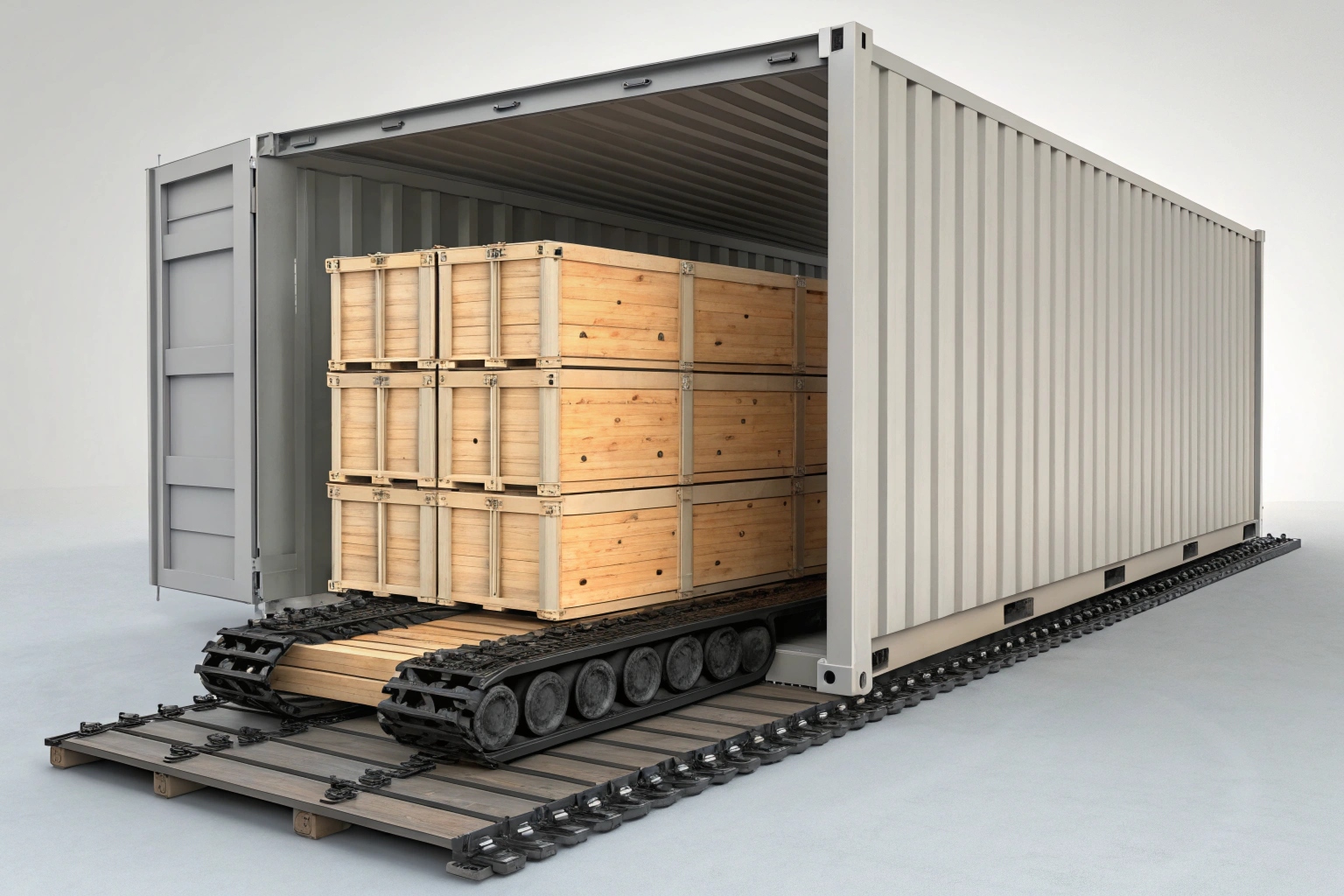
Optimizing a container for undercarriage parts is a specific science. Unlike shipping clothing or electronics, where volume (CBM) is the main constraint, undercarriage parts are incredibly dense and heavy. With steel track shoes and chains, we almost always hit the container's weight limit long before we fill it to the roof with volume. A 20ft container might look only half full visually, but it is already at its maximum weight capacity of roughly 28 tons (depending on the specific shipping line and local road regulations).
To get the best "bang for your buck," we recommend a strategy of mixing high-density items with lower-density items.
- High Density (The Anchor): Track chains, track rollers, and assembled track shoes. These consume weight rapidly but take up little floor space.
- Lower Density (The Filler): Track guards, empty buckets (if you source them), or lighter sheet metal components.
- Gap Fillers: Track bolts and nuts. These are heavy but small boxes that can be placed in the "dead space" between pallets to stabilize the load and reach the exact weight target.
We follow a strict "Heavy Down, Light Up" safety protocol when planning your load. We place the heaviest pallets—such as D8 or D9 track assemblies—directly on the container floor over the main beams. This keeps the center of gravity 9 low, which is crucial for stability during rough seas. Lighter pallets are stacked on top or towards the nose of the container. We also use professional blocking and bracing with certified lumber to ensure that nothing shifts. A mixed load has irregular shapes, so this bracing is even more important than in a uniform load.
When you send us your initial inquiry, simply tell us: "I want to fill a 20ft container." We will calculate the total weight of your requested items. If your list only comes to 18,000 kg, we will actively inform you: "David, you have space for another 7,000 kg or 5 pallets. We recommend adding fast-moving consumables like track bolts or perhaps increasing the quantity of the PC200 rollers." This proactive planning ensures you never pay the full freight rate for a container that is only 70% utilized. We also keep a close eye on the axle weight limits for US roads. We know that once the container hits the US port, it needs to be trucked to your warehouse. We distribute the weight inside the container to ensure it is legal for US highway transport, preventing fines or delays at the weigh station 10.
Conclusion
Mixing different track shoe models in one container is a smart way to manage your inventory and cash flow. We make it safe and efficient by handling all the complex labeling, detailed documentation, and weight distribution planning for you. You don't have to worry about warehouse chaos or wasted freight costs.
Footnotes
1. Breakdown of the total price of a product including shipping. ↩︎
2. Lean strategy for communicating status and data visually. ↩︎
3. Integrated software for managing core business processes. ↩︎
4. Standardized codes for classifying international trading goods. ↩︎
5. Federal agency regulating trade and border security. ↩︎
6. Outsourcing of ecommerce logistics and fulfillment services. ↩︎
7. The net amount of cash transferring into and out of a business. ↩︎
8. Shipping method for loads not filling a full container. ↩︎
9. Point where total weight is considered to be concentrated. ↩︎
10. Checkpoint to inspect truck weight and compliance. ↩︎